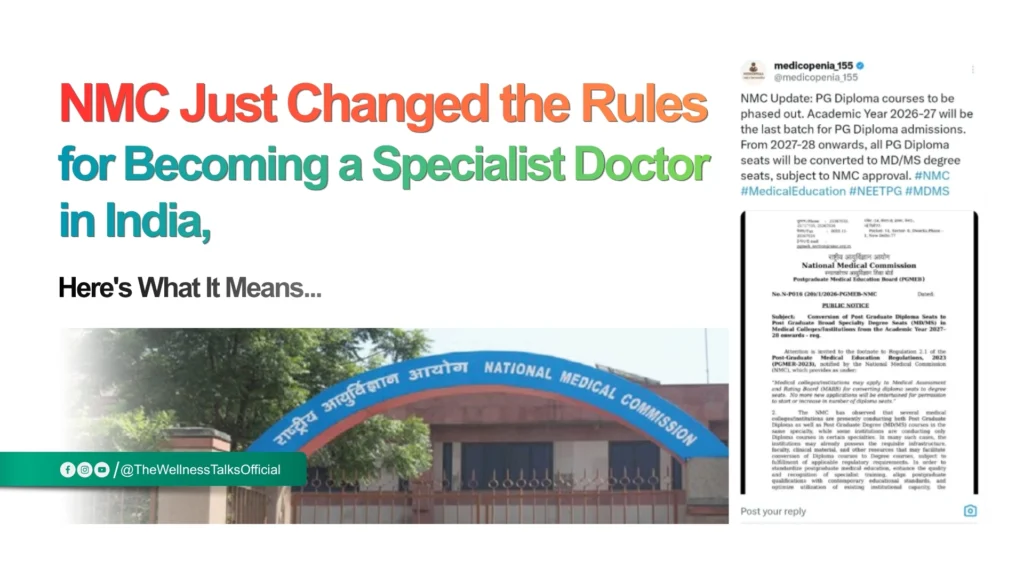
The National Medical Commission (NMC) has decided to phase out postgraduate (PG) diploma medical courses across India. The 2026-27 academic session will be the last year for diploma admissions. From 2027-28 onward, no fresh diploma admissions will be allowed, and colleges must convert these seats into MD or MS degree programmes through the Medical Assessment and Rating Board (MARB).
NMC Update: PG Diploma courses to be phased out. Academic Year 2026-27 will be the last batch for PG Diploma admissions. From 2027-28 onwards, all PG Diploma seats will be converted to MD/MS degree seats, subject to NMC approval. #NMC #MedicalEducation #NEETPG #MDMS pic.twitter.com/lrCf3oxIi6
— medicopenia_155 (@medicopenia_155) June 22, 2026
Introduction
India’s postgraduate medical education system is about to undergo one of its most significant structural changes in years.
The National Medical Commission (NMC) has formally announced that postgraduate diploma medical courses will be discontinued in a phased manner, with full transition to MD (Doctor of Medicine) and MS (Master of Surgery) degree programmes.
For decades, PG diplomas offered a shorter, more accessible route into specialist medical practice, especially in fields like anaesthesia, radiology, ENT, dermatology, and obstetrics. That route is now closing.
This article breaks down what the NMC has announced, why it matters for doctors and patients alike, and what students and institutions need to do next.
What Happened?
On June 22, 2026, the NMC issued a formal communication to all medical colleges, institutions, and universities under its jurisdiction, directing them to comply with a public notice released by the Postgraduate Medical Education Board (PGMEB) on June 19, 2026.
The core decision is straightforward:
- 2026-27 will be the last academic year for admissions to PG diploma medical courses.
- From 2027-28 onward , no new admissions will be permitted to any PG diploma programme.
- Once admissions stop, diploma courses will cease to function entirely.
- All existing PG diploma courses must be converted into corresponding MD or MS degree courses .
The directive draws on a footnote under Regulation 2.1 of the Post-Graduate Medical Education Regulations, 2023 (PGMER-2023). This provision allows medical colleges to apply to the Medical Assessment and Rating Board (MARB) to convert diploma seats into degree seats. At the same time, it explicitly blocks any fresh applications to start new diploma courses or increase diploma seat numbers.
The communication was issued under the authority of NMC Secretary Dr Raghav Langer, who asked institutions to take note of the public notice and ensure compliance with the conversion procedure.
According to the NMC, a dedicated application window will be activated on its online portal specifically for this conversion process. MARB is expected to release detailed instructions on the application format and timelines in a separate notice. Approval for conversion will depend on whether a college meets the infrastructure, faculty, and clinical material standards that NMC prescribes from time to time.
The Commission also pointed out a practical reality on the ground: many medical colleges already run both diploma and degree (MD/MS) courses in the same specialty, while a smaller number of institutions currently offer only the diploma option. NMC believes a large share of these colleges already have the faculty strength, patient load, and infrastructure needed to convert their diploma seats into full degree seats without much additional investment.
NMC to phase out PG Diploma courses after the 2026-27 academic session. Existing diploma seats will be converted into MD/MS seats, bringing specialist medical training under a unified degree framework. Medical colleges have been directed to apply for seat conversion through MARB.… pic.twitter.com/Pg1YqIRWhz
— medicopenia_155 (@medicopenia_155) June 23, 2026
Why This News Matters
This is not a minor administrative tweak. It changes the structure of specialist medical training for the entire country.
PG diploma courses have long served as a shorter, more affordable, and often more accessible pathway for doctors to gain specialist skills, particularly for those who could not secure a seat in the more competitive MD/MS programmes.
Phasing them out means:
- Future specialists in fields like anaesthesia, radiology, ENT, ophthalmology, and obstetrics will need to qualify through MD/MS degrees only.
- Medical colleges that relied on diploma courses to train specialists in under-served disciplines must now upgrade their infrastructure to degree-level standards.
- The competitive landscape for postgraduate medical seats, already intense under NEET-PG, will shift further, since the diploma route is being removed as an alternative.
For a country that already faces a shortage of specialist doctors in semi-urban and rural areas, any change to how specialists are trained carries consequences well beyond classrooms and campuses.
Expert Insights
Medical education observers note that this move has been anticipated since the PGMER-2023 regulations were notified, which already signalled NMC’s intent to standardise postgraduate qualifications and reduce the parallel diploma-versus-degree system.
Health policy analysts point out that a single, unified MD/MS pathway could help streamline how specialist qualifications are recognised, both within India and internationally, where diploma-holders have sometimes faced inconsistent recognition compared to degree-holders.
At the same time, experts in medical education caution that conversion needs to be handled carefully. Colleges that currently run only diploma courses, particularly in smaller cities, may need real investment in faculty and infrastructure to meet MD/MS-level requirements. If that support isn’t provided, some of these institutions could end up with fewer specialist training seats rather than more, at least in the short term.
Impact on Public Health / Wellness
For the wider public, this reform connects directly to the availability of specialist healthcare.
PG diploma courses have historically helped staff smaller hospitals and nursing homes with trained specialists in anaesthesia, radiology, obstetrics, and similar fields, often in tier-2 and tier-3 cities. A smooth, well-funded conversion to MD/MS could:
- Improve the overall quality and depth of specialist training, since MD/MS programmes typically involve a longer academic curriculum and broader research exposure.
- Strengthen the credibility of Indian postgraduate medical degrees on the global stage.
- Standardise patient care protocols, since specialists trained through one consistent degree pathway are likely to follow more uniform clinical standards.
However, if the conversion process is slow or seat numbers temporarily shrink during the transition, some regions could see a short-term dip in the number of new specialists entering practice, particularly in fields and locations that depended heavily on diploma-trained doctors.
Important Statistics and Data
- According to NMC’s own seat-matrix data, India had 49,772 postgraduate medical seats spread across 81 specialities in a recent academic cycle, with the largest share concentrated in MD General Medicine.
- The total approved PG seat count, combining MD, MS, and PG Diploma programmes, has been reported at roughly 52,000+ seats for a recent academic year, reflecting the scale of postgraduate medical training nationwide.
- PG diploma seats exist across a wide range of disciplines, including anaesthesia, child health, radio-diagnosis, ENT (oto-rhino-laryngology), clinical pathology, obstetrics and gynaecology, ophthalmology, orthopaedics, and dermatology, venereology and leprosy, among others.
- Several medical colleges across India currently run both diploma and MD/MS programmes in the same specialty, which NMC says puts them in a strong position to convert smoothly.
- A smaller subset of institutions currently offer only the diploma route in certain specialities, and these are the colleges most likely to need additional support during conversion.
These figures illustrate why the phase-out is being described as one of the larger structural shifts in Indian postgraduate medical education in recent years.
What People Should Know
If you are a current or aspiring NEET-PG candidate:
- The 2026-27 academic session is your last opportunity to seek admission into a PG diploma course, if that is the pathway you were considering.
- From the 2027-28 admission cycle, diploma seats will not appear in the counselling process; only MD/MS seats (converted or original) will be available.
- Start tracking NMC and MARB notices closely, since seat-matrix numbers for MD/MS programmes may shift as colleges convert their diploma seats.
If you are already enrolled in a PG diploma course:
- Currently running diploma batches are not affected retroactively by this notice; the change applies to future admissions, not to students already studying.
- Always verify directly with your institution and NMC’s official notices for the most current guidance specific to your batch.
If you are associated with a medical college or institution:
- Begin preparing documentation on faculty strength, clinical material, and infrastructure, since conversion approval depends on meeting MD/MS-level standards.
- Applications for conversion must be submitted to MARB through NMC’s online portal once the dedicated module is activated.
- No new diploma seats, and no increase in existing diploma seats, will be approved going forward.
Future Outlook
The shift from PG diplomas to a fully MD/MS-based postgraduate system is expected to unfold over the next two to three academic cycles, rather than overnight.
In the near term, expect:
- MARB to release a detailed conversion application process and timeline.
- Medical colleges to begin submitting conversion applications for their existing diploma seats.
- Possible adjustments to the overall PG seat matrix as colleges complete the switch from diploma to degree status.
Over the longer term, if implemented well, this reform could create a more uniform, globally comparable system of specialist medical qualifications in India, one where every postgraduate specialist holds an MD or MS rather than a mix of degrees and diplomas. The success of that vision will depend heavily on how well under-resourced colleges are supported through the conversion process.
Key Takeaways
- NMC will phase out all PG diploma medical courses nationwide, replacing them with MD/MS degree programmes.
- 2026-27 is the last academic year for PG diploma admissions; from 2027-28, no fresh diploma admissions will be allowed.
- The decision is based on a footnote under Regulation 2.1 of the Post-Graduate Medical Education Regulations, 2023 (PGMER-2023).
- Colleges running diploma courses must apply to the Medical Assessment and Rating Board (MARB) to convert seats into MD/MS seats.
- No new applications will be accepted to start fresh diploma courses or increase diploma seat numbers.
- The move aims to standardise postgraduate medical education and align Indian specialist qualifications with global standards.
- Students currently enrolled in diploma courses are not affected; the change applies to future admission cycles only
Frequently Asked Questions (FAQs)
1. What has the NMC decided about PG diploma medical courses?
The NMC has decided to phase out all postgraduate diploma medical courses across India and convert them into MD or MS degree programmes, standardising postgraduate medical education nationwide.
2. When will PG diploma admissions stop completely?
The 2026-27 academic session is the last year for PG diploma admissions. From the 2027-28 academic year onward, no fresh admissions will be permitted to any diploma programme.
3. What happens to students currently studying in PG diploma courses?
Students already enrolled are not affected by this notice. It applies only to future admission cycles, not to ongoing diploma batches.
4. Will diploma seats simply disappear, or will they be converted?
Existing diploma seats are expected to be converted into corresponding MD or MS degree seats, subject to approval from the Medical Assessment and Rating Board (MARB) and the college meeting required standards.
5. Why is the NMC phasing out PG diploma courses?
The stated goal is to standardise postgraduate medical education, improve the quality and recognition of specialist training, align qualifications with contemporary educational standards, and make better use of existing institutional capacity.
6. How can a medical college convert its diploma seats into MD/MS seats?
Colleges must submit an application to the Medical Assessment and Rating Board (MARB) through a dedicated module on the NMC’s online portal, once it is activated. Approval depends on meeting NMC’s prescribed infrastructure, faculty, and clinical standards.
7. Does this affect NEET-PG counselling for 2027 and beyond?
Yes. From the 2027-28 counselling cycle, PG diploma seats will no longer be part of the seat matrix offered through NEET-PG counselling; only MD/MS seats will be available.
8. Is this the first time NMC has restricted PG diploma courses?
The current notice builds on the Post-Graduate Medical Education Regulations, 2023 (PGMER-2023), which already laid the regulatory groundwork by allowing diploma-to-degree seat conversion and barring new diploma seat approvals.
9. Will this reform affect the total number of specialist doctors trained each year?
It could, at least temporarily. If colleges that currently run only diploma courses face delays in meeting degree-level standards, the number of new specialist seats in certain disciplines and regions may see a short-term dip during the transition.
Conclusion
The NMC’s decision to phase out PG diploma medical courses marks a major shift toward a single, standardised postgraduate medical qualification system built around MD and MS degrees.
For aspiring doctors, the message is clear: the 2026-27 academic year is the last window for the diploma route, and all future planning should factor in a degree-only postgraduate landscape from 2027-28 onward.
For medical colleges, the priority now is preparing for conversion, upgrading infrastructure where needed, and engaging with MARB’s process well ahead of the deadline.
As with any major policy shift in medical education, the real impact will depend on execution: how smoothly colleges convert their seats, and how well India’s specialist training capacity is preserved, or even strengthened, through the transition.