
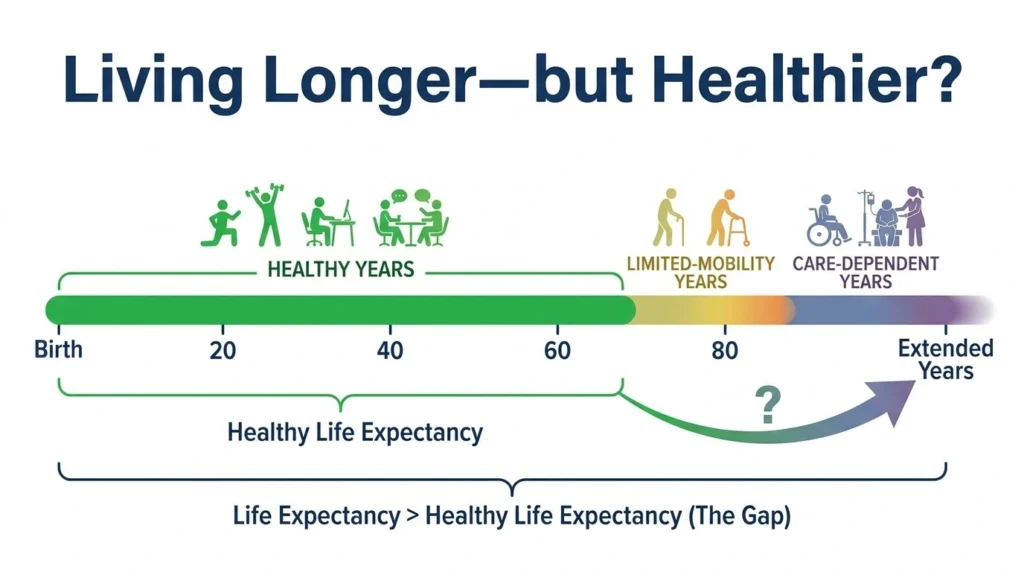
People around the world are living longer again after the disruption of the COVID-19 pandemic. Yet the number of years lived in good health has not recovered as quickly. The latest WHO estimates suggest that the next major health challenge is not merely adding years to life, but reducing the time people live with preventable illness, disability, pain, and poor mental health.
Two different ways to measure a longer life
Life expectancy estimates how many years a person can expect to live if current patterns of mortality continue. It is a broad measure of whether populations are surviving infancy, infections, injuries, childbirth, chronic diseases, and old age.
Healthy life expectancy asks a different question: how many of those years are likely to be lived in reasonably good health?
According to WHO, global life expectancy reached 73.3 years in 2023, almost matching the 73.4 years recorded in 2019. Healthy life expectancy reached 62.8 years, still 0.4 years below its 2019 level.
This does not mean everyone will spend the final decade of life seriously ill. Population averages cannot predict an individual future. They do show that death rates and day-to-day health do not always improve at the same speed.
A country can successfully prevent early death while many people continue living with arthritis, diabetes, cardiovascular disease, depression, dementia, impaired vision, chronic lung disease, or complications following an infection.
Chronic diseases now dominate the global picture
WHO estimates that noncommunicable diseases, often called NCDs, caused 74% of global deaths in 2023, compared with 58% in 2000. Eight of the ten leading causes of death were noncommunicable conditions.
These diseases are not passed from one person to another. The broad group includes cardiovascular disease, cancer, diabetes, chronic respiratory disease, and many neurological conditions.
The shift partly reflects progress. As fewer people die young from certain infections or complications of childbirth, more people survive to ages at which chronic diseases are common. However, ageing alone does not explain everything.
Tobacco use, air pollution, inadequate physical activity, high blood pressure, harmful alcohol use, poor access to nutritious food, and delayed medical care contribute to the burden. So do genetics, social inequality, unsafe work, limited preventive services, and environments that make healthy choices difficult.
The global picture is therefore not “infectious disease has disappeared.” Communicable diseases remain serious threats, particularly in countries with limited resources. Rather, many health systems must now manage infections and an expanding chronic-disease burden at the same time.
Heart disease still causes the largest burden
Ischaemic heart disease remained the leading cause of death and lost healthy life worldwide. WHO estimated that it caused approximately 9.5 million deaths in 2023.
There has been meaningful progress in reducing heart-disease risk in many populations since 2000. Yet WHO found that individual-level risk increased in parts of the Western Pacific and South-East Asia.
This is especially relevant to readers in India. High blood pressure and diabetes may develop without obvious symptoms. Waiting to feel ill can allow years of damage to the heart, blood vessels, kidneys, eyes, and brain.
Basic preventive care is not glamorous, but it matters: check blood pressure, understand blood-sugar risk, avoid tobacco, remain physically active, and seek qualified care for persistent symptoms.
Risk reduction is not a guarantee that disease will never occur. It changes probability. Age, family history, medical conditions, and social circumstances still matter.
Diabetes and dementia are rising concerns
WHO reported that the risk of dying from diabetes has risen substantially since 2000, particularly in South-East Asia.
Diabetes is not simply “too much sugar in the blood” after eating sweets. It is a metabolic condition involving insulin production, insulin action, or both. Diet and activity matter, but family history, age, pregnancy history, sleep, medicines, body-fat distribution, and other biological factors also influence risk.
Dementia has also become more prominent. WHO reported that Alzheimer disease and other dementias became the fifth leading global cause of death in 2023, rising from nineteenth place in 2000. Recorded dementia deaths tripled over that period.
Some of this increase reflects population ageing, better recognition, and changes in how deaths are recorded. It does not mean an unexplained epidemic suddenly appeared.
There is no guaranteed method of preventing dementia. Supporting cardiovascular health, treating hearing loss, staying physically and socially active, avoiding smoking, and managing conditions such as hypertension may help reduce risk. These steps should be presented as risk reduction—not as a promise that dementia can be prevented.
Mental health is part of healthy life expectancy
Living longer while experiencing disabling anxiety or depression is not the same as living well.
WHO estimated that between 2019 and 2023, the age-standardized rate of healthy life lost to depressive disorders increased by approximately 20%, while the rate associated with anxiety disorders increased by nearly 45%. Together, the conditions represented an estimated 110 million years of healthy life lost in 2023.
These are modelled population estimates, not a count of people who received a diagnosis. They are still an important reminder that mental health cannot be separated from overall health.
Anxiety and depression can affect sleep, relationships, work, physical activity, medication use, and the ability to seek care. Chronic pain and physical illness can worsen emotional health in return.
Support may include counselling, social connection, changes at work, treatment of an underlying condition, structured psychological therapy, medication, or a combination. Persistent symptoms deserve assessment rather than dismissal as weakness.
What these global figures cannot tell an individual
Global estimates combine data from countries with very different reporting systems. In places where death certification or disease surveillance is incomplete, statisticians use modelling to fill gaps.
That does not make the estimates meaningless. It means they should be interpreted at the correct scale. They reveal broad patterns and help governments decide where services and research are needed. They cannot predict how long a particular person will live or diagnose their health.
They also describe the world through 2023, although the report was released in 2026. The figures should not be presented as direct counts for October 2026.
Turning longer life into healthier life
Healthy ageing begins long before old age. It is built through childhood nutrition, education, vaccination, safe housing, clean air, preventive healthcare, meaningful work, and protection from violence and injury.
At an individual level, a useful starting point is to know the quiet risk factors. Blood pressure, blood sugar, cholesterol, dental health, vision, hearing, sleep, and emotional health all deserve attention.
Movement does not have to mean a gym membership. Walking, climbing stairs, gardening, household work, dancing, cycling, yoga, and strength exercises can all contribute. The safest approach depends on age, disability, pregnancy, symptoms, and existing disease.
Food patterns matter more than a single “superfood.” Meals built around vegetables, fruit, pulses, whole grains, nuts, and suitable protein sources can support long-term health. Tobacco avoidance remains one of the most powerful protective steps.
Equally important, people need healthcare that is affordable and reachable. Advice has limited value when medicines are unaffordable, pavements are unsafe, work hours are unpredictable, or nutritious food is unavailable.
The WHO update therefore carries a message for both individuals and institutions. People can reduce risk, but governments, employers, communities, and health systems determine how realistic those choices become.
Practical takeaways
- Distinguish total lifespan from years lived in good health.
- Check important risks such as blood pressure and blood sugar before symptoms appear.
- Treat mental health, hearing, mobility, and social connection as parts of healthy ageing.
- Choose sustainable movement and eating habits rather than extreme programmes.
- Remember that global estimates guide policy; they do not predict an individual lifespan.
FAQs
What is healthy life expectancy?
It estimates the average number of years a population can expect to live in good health, after accounting for illness and disability.
Is global life expectancy increasing again?
WHO estimates that it reached 73.3 years in 2023, close to the pre-pandemic level recorded in 2019.
Why can healthy life expectancy lag behind total life expectancy?
Medical care may help people survive conditions that still cause disability, pain, reduced mobility, or long-term treatment needs.
What causes most deaths worldwide?
WHO estimates that noncommunicable diseases caused 74% of global deaths in 2023.
Is dementia now more common?
Recorded dementia burden has risen, influenced by ageing populations, greater recognition, longer survival, and other factors. The figures do not identify one single cause.
Can lifestyle prevent every chronic disease?
No. Healthy habits can reduce risk, but they cannot eliminate the effects of age, genetics, environmental exposure, and other medical factors.
What should a beginner do first?
Arrange appropriate preventive checks, avoid tobacco, establish regular movement, and discuss persistent physical or emotional symptoms with a qualified professional.
References
- World Health Organization, New WHO Estimates Show Changing Global Health Landscape, October 2, 2026. who.int
- WHO, Cancer Fact Sheet, updated July 3, 2026.